
Why does a copper tube sometimes feel harder during installation? What are the different levels of copper tube hardness used by Ruby Copper, and why are multiple hardness grades necessary?
What Is Copper Tube Hardness?
Definition of Copper Tube Hardness
Copper tube hardness is one of the fundamental properties of copper materials. It reflects the tube’s resistance to bending, abrasion, scratches, and surface deformation. In simple terms, hardness measures how well a material can resist indentation when pressure is applied by a harder object.
The higher the copper tube hardness, the greater the material’s strength and resistance to deformation. At the same time, tubes with higher hardness are generally less flexible and more difficult to bend.
By evaluating copper tube hardness, manufacturers and users can estimate both the durability and ductility of a copper tube.
Many people assume that a metal material only has one hardness level. In reality, copper can have different hardness grades depending on the manufacturing process and heat treatment applied during production.
At Ruby Copper, copper tube hardness is strictly controlled according to international quality standards, including:
- JIS H3300 Japanese Industrial Standards
- ASTM B280, ASTM B88, ASTM B68, ASTM B75
- EN 12449 and EN 12735 European standards

According to these standards, this is generally divided into four categories, arranged from highest to lowest hardness:
- Hard copper tube
- Half-hard copper tube
- Bright annealed copper tube
- Soft annealed copper tube
How Different Copper Tube Hardness Levels Are Produced
Crystal Structure and The Hardness Of Copper Tube
Like other metals, copper is made up of countless copper atoms arranged in a crystal lattice structure. When copper is in a molten state, these crystal structures move freely and randomly. As the metal cools below its melting temperature, the crystals reorganize into a stable solid structure.
The hardness largely depends on the size and arrangement of these crystal grains.
Using specialized annealing technology, manufacturers such as Ruby Copper can precisely control the crystal grain size and distribution within the copper material. This process allows the production of copper tubes with different hardness levels that meet both international standards and customer requirements.
Copper tubes with larger and more widely spaced crystal grains are softer, more flexible, and easier to bend. Meanwhile, tubes with smaller and denser crystal structures exhibit higher copper tube hardness and greater rigidity.
Why Are Different Copper Tube Hardness Levels Necessary?
Copper Tube Hardness for Different Applications
Each copper tube hardness grade is designed for a specific application.
Soft Annealed Copper Tubes
Soft copper tubes are ideal for applications requiring extensive bending, shaping, or manual installation. They are commonly used in air conditioning systems, especially for connecting indoor and outdoor HVAC units.
Because of their low copper tube hardness, installers can easily bend and shape the tubing during installation.
Harder Copper Tubes
Copper tubes with higher hardness are more suitable for applications requiring minimal bending or where specialized processing equipment is available.
These products are widely used by manufacturers of:
- HVAC equipment
- Refrigeration accessories
- Medical equipment
- Industrial cooling systems
- Construction and mechanical systems
Ruby Copper serves customers across multiple industries, each with unique requirements for copper tube hardness depending on their production processes and application environments.

Therefore, every production batch is manufactured according to agreed technical specifications and intended usage.
Copper Tube Hardness Standards for Different Markets
International Requirements for Copper Tube Hardness
For the domestic HVAC installation market, soft annealed copper tubes are the most commonly used because they simplify installation and improve flexibility during field operations.
However, exported products must comply with the technical requirements of each international market.
For example:
- The Japanese market requires compliance with JIS H3300 standards
- European markets require EN standards
- The US market follows ASTM standards
- The Australian market applies AS/NZS standards
Although these standards share common technical principles, each market may specify slightly different copper tube hardness ranges and performance values.
As a result, even products classified under the same hardness condition may have different acceptable parameter ranges depending on the applicable standard.
Why Does a Copper Tube Feel Harder During Installation?
Work Hardening and Copper Tube Hardness
During air conditioner installation, technicians sometimes notice that a copper tube becomes harder and more difficult to bend after repeated handling.
This phenomenon does not only occur with Ruby Copper products. It is a natural characteristic found in all copper tubes and metal materials.
The reason is called “work hardening” or “strain hardening,” which is a common physical property of metals.
As mentioned earlier, copper consists of crystal lattice structures. When the tube undergoes bending, flaring, stretching, or repeated deformation, these crystal structures break and shift.
The broken crystal grains become smaller and pack more tightly together, increasing the copper tube hardness. This structural change reduces flexibility and makes the tube harder to shape.
This explains why copper tubes that experience less mechanical processing generally retain their original softness and flexibility.
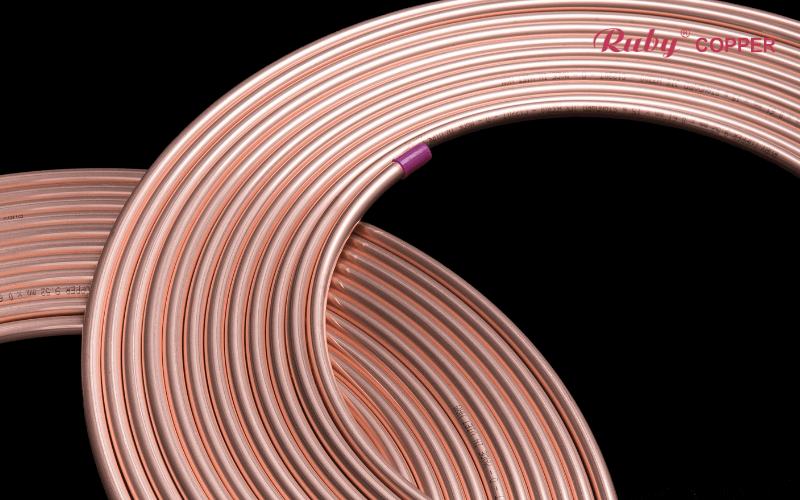
To minimize work hardening during installation, technicians should:
- Plan tubing routes carefully
- Reduce unnecessary bending
- Use proper bending tools such as tube benders or bending springs
- Avoid excessive external force on the copper tube
Conclusion
Copper tube hardness plays a critical role in determining the flexibility, durability, and application suitability of copper tubing products.
By controlling crystal structure and annealing technology, Ruby Copper manufactures copper tubes with various hardness levels that comply with international standards and meet the diverse needs of global customers.
Understanding copper tube hardness helps installers, contractors, and manufacturers choose the right tubing solution for maximum performance, easier installation, and longer service life.


