
Non-destructive testing for copper tubes is a specialized inspection method widely used in engineering and manufacturing industries. In copper tube production, it is considered an indispensable process for manufacturers that aim to deliver high-quality products. To better understand this important activity, let’s take a closer look at how it is implemented at Ruby Copper.
I. What Is Non-Destructive Testing for Copper Tubes?
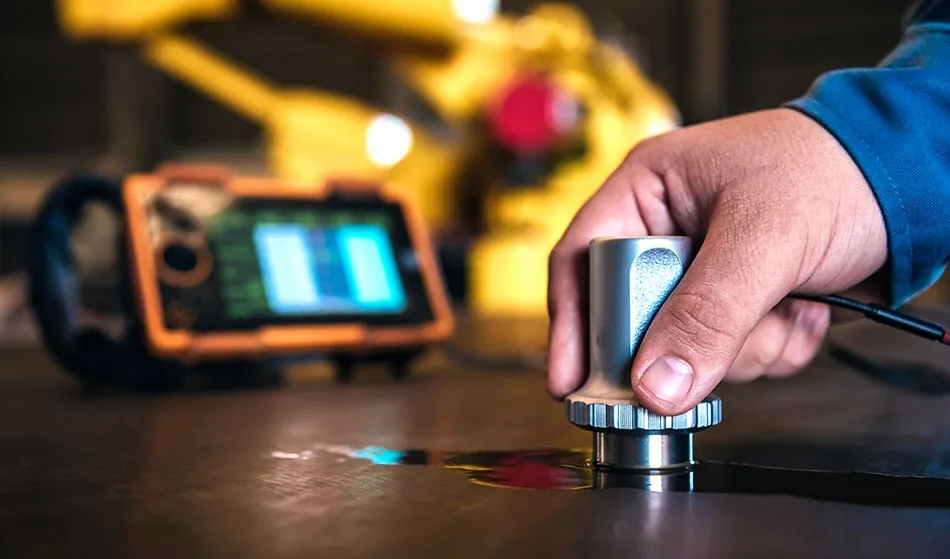
Basically, non-destructive testing for copper tubes is a method used to detect internal and surface defects without causing any deformation or damage to the product.
Unlike destructive testing methods, inspectors do not cut, break, hammer, or separate the sample during the inspection process. Instead, manufacturers use techniques involving water pressure, air pressure, electromagnetic signals, and other testing methods to evaluate product integrity.
Today, non-destructive testing for copper tubes is widely applied across various industries, including mechanical engineering, metallurgy, and construction.
In the copper tube manufacturing industry, it is one of the eight fundamental quality tests referenced by major international standards such as JIS H3300, ASTM B280, ASTM B68, EN 1057, and AS/NZS 1571.
The purpose of this inspection is to identify cracks, pinholes, porosity, and other defects while also checking for material delamination that may affect product performance.
II. Why Is Non-Destructive Testing Widely Trusted?
The widespread use of non-destructive testing for copper tubes is no coincidence. Its advantages can be summarized in four key aspects.
Material Savings
Since the product remains intact throughout the inspection process, manufacturers can significantly reduce material waste and testing costs.
Safety
One of the greatest benefits of non-destructive testing for copper tubes is that it can be performed without creating hazards for operators or damaging valuable products.
Efficiency
The method provides detailed inspection results in a relatively short period of time, helping manufacturers maintain production efficiency.
Accuracy
Although certain non-destructive tests are not mandatory under all standards, they are frequently performed due to their high accuracy and reliability in identifying hidden defects.
III. Non-Destructive Testing in Ruby Copper’s Manufacturing Process
At Ruby Copper, non-destructive testing for copper tubes primarily consists of two major inspection procedures:
- Eddy current defect testing
- Water pressure and air pressure leak testing
All inspections are conducted under strict quality control procedures and fully comply with the requirements of the Japanese Industrial Standard JIS H3300.
1. Eddy Current Defect Testing
Eddy current testing is applied to most products manufactured by Ruby Copper.
To detect cracks, holes, and surface defects on copper tubes, Ruby Copper utilizes advanced inspection equipment supplied by Prüftechnik (Germany).
This non-destructive testing for copper tubes method operates by collecting and analyzing electrical signals.
The process works as follows:
- The inspection system generates eddy currents inside the copper tube.
- As the probe moves along the tube, the eddy currents react and send signals back to the detector.
- Abnormal signals indicate potential defect locations.
- Quality control technicians then identify and evaluate the defect based on signal characteristics.
Thanks to this technology, non-destructive testing for copper tubes can detect even very small imperfections with high accuracy.
2. Water Pressure and Air Pressure Leak Testing
Water Pressure Testing
For copper tubes used in air conditioning and refrigeration applications, the specified hydrostatic test pressure is 6.35 MPa.
This stage of non-destructive testing for copper tubes verifies the structural integrity of the tube and ensures that it can withstand operating pressure safely.
Air Pressure Testing
Air pressure testing is performed by applying a pressure of at least 0.4 MPa and submerging the tube in water for a minimum of five seconds.
Any air bubbles indicate leakage and result in product rejection.
IV. Ruby Copper’s Commitment to Quality
The information above provides a basic overview of non-destructive testing for copper tubes and its practical application within Ruby Copper’s manufacturing process.
Ruby Copper firmly believes that a systematic and rigorous inspection program is essential for continuous quality improvement and long-term product reliability.
Through comprehensive non-destructive testing for copper tubes, Ruby Copper has successfully obtained internationally recognized certifications and complies with standards such as JIS H3300, ASTM B280, and ASTM B68.
These achievements demonstrate the company’s commitment to producing premium-quality copper tubes and supporting the global growth of Vietnamese copper tube manufacturing through reliable non-destructive testing for copper tubes.


