

A. Continuous Casting and Rolling
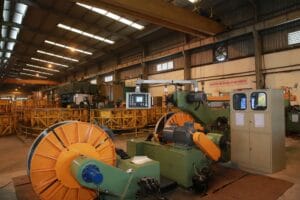
The continuous casting and rolling process is a fully enclosed production system that integrates melting, casting, surface milling, and rolling into a seamless operation.
High-purity copper cathodes (Cu ≥ 99.95%) and selected recycled copper are melted in a single furnace. To remove dissolved oxygen and improve copper quality, Cu-P alloy (13–15% phosphorus) is added at a rate of 1.8–1.9 kg per ton of copper. The melting capacity is approximately 1 ton per hour.
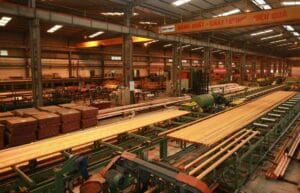
The molten copper is continuously cast into a mother tube with an outside diameter of 90 mm and a wall thickness of 23.5 mm. Each tube is cut to a maximum length of 19 m, weighing approximately 890 kg.
The mother tube then undergoes straightening and precision surface milling, where approximately 4% of the material is removed to eliminate surface defects. The recovered copper chips are recycled directly back into the melting furnace.
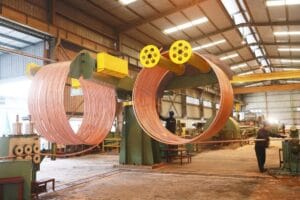
Following surface preparation, the tube is processed on a planetary rolling mill, reducing its dimensions to an outside diameter of 48–50 mm and a wall thickness of 2.3–2.5 mm. Rolling is performed at a speed of 12–18 m/min before the tube is coiled for the next production stage.
B. Combined Drawing
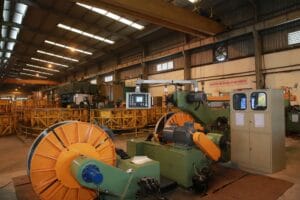
The rolled tube is transferred to a horizontal combined drawing machine, where it is further reduced to the required intermediate dimensions.
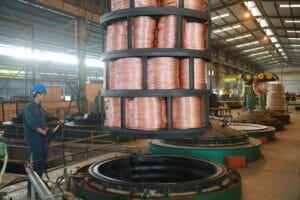
The drawing process operates at a speed of 40–50 m/min, and the finished tube is automatically coiled into a material cage with a diameter of 2.2 m for subsequent processing.
After this stage, the tube reaches an intermediate size of 38 mm × 1.75 mm, providing the required dimensional accuracy for the following manufacturing processes.


C. Final Drawing
After the combined drawing stage, the coiled tube is transferred to a spinner block drawing machine for final size reduction.
The tube passes through a series of precision inner and outer dies, where both the outside diameter and wall thickness are gradually reduced to the required final dimensions. Depending on the product specification, the maximum drawing speed can reach 1,000 m/min.
This process enables the production of copper tubes with diameters as small as 4 mm, ensuring excellent dimensional accuracy and consistent mechanical properties.
D. Coiling and Straight Tube Processing
Following final drawing, the finished tubes are transported by overhead crane to the appropriate downstream equipment according to product type.
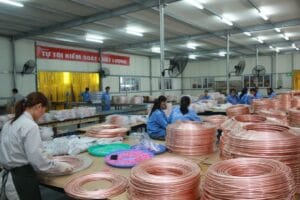
Copper tubes are processed into either Level Wound Coils (LWC), Pancake Coils (PC), or straight tubes.
For straight tubes with diameters exceeding 22.22 mm, which are beyond the capacity of the spinner block drawing machine, production is carried out on a dedicated straight-tube drawing line. The input material is supplied directly from either the rolling or combined drawing process, with a maximum finished diameter of 42 mm.
E. Annealing
LWC and PC copper tubes undergo an annealing process to optimize their metallurgical structure and mechanical performance.
Annealing relieves internal stress, refines the grain structure, maintains a clean and uniform surface appearance, and reduces hardness to meet customer specifications. The process is carried out in a protective atmosphere furnace using a controlled mixture of nitrogen (N₂) and hydrogen (H₂) gases to prevent oxidation and preserve surface quality.
Straight copper tubes do not require annealing.
F. Packing
Finished products are packed according to their product type and customer requirements.
- Level Wound Coils (LWC): Packed on durable wooden bobbins for safe transportation and automated production lines.
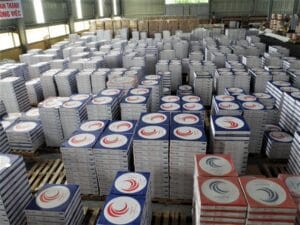
- Pancake Coils (PC): Packed in sturdy carton boxes to protect the coils during handling and shipment.
- Straight Tubes: Wrapped with protective nylon packaging to prevent damage and contamination.
Customized packaging solutions are also available to meet specific customer specifications, transportation methods, and export requirements.


