

When sourcing copper tubes for international HVAC projects, standards are an important part of supplier qualification. Two standards that buyers may encounter are KS D 5301 vs ASTM B280.
Although both standards address seamless copper tubes, they do not have the same scope. Their technical purposes and application focus are different.
Understanding these differences helps contractors, OEM manufacturers, distributors, and project procurement teams select the appropriate specification.
This article compares KS D 5301 vs ASTM B280 based on information available from the Korean national standards system and ASTM International.
KS D 5301 and ASTM B280: Different Standard Scopes
The first point to understand is the scope of each standard.
According to Korea’s official e나라 표준인증 database, KS D 5301 is titled “Seamless Copper and Copper Alloy Tubes.” Its scope covers seamless copper and copper alloy tubes with a round cross-section that are produced through working processes. The standard was established in 1980 and its latest confirmation date is April 22, 2024.
By comparison, ASTM B280-23 is titled “Standard Specification for Seamless Copper Tube for Air Conditioning and Refrigeration Field Service.” ASTM states that it covers seamless copper tubes intended for connections, repairs, or alterations of field air-conditioning and refrigeration units.
This creates the first major difference in KS D 5301 vs ASTM B280.
KS D 5301 has a broader product scope. ASTM B280 has a more specific application focus.
Therefore, the two standards should not be treated as interchangeable simply because both cover seamless copper tubes.
KS D 5301 vs ASTM B280: Materials and Product Designation
Material requirements are another important consideration.
The official Korean standard database identifies KS D 5301 as covering both copper and copper alloy seamless tubes.
A Korean government guide for KS product designation also lists several copper and copper alloy grades under KS D 5301. These include C1020, C1100, C1201, C1220, C2200, C2300, C2600, C2700, C2800 and other grades. The same guide shows product designations using material, grade, temper, and nominal dimensions.
ASTM B280-23 is more specific. ASTM states that tubes covered by the specification are produced from UNS C10200, C12000, or C12200 copper.
This difference is important when comparing KS D 5301 vs ASTM B280 for procurement.
A tube manufactured under KS D 5301 may fall within a wider range of material designations. ASTM B280 identifies a specific group of copper materials for its application.
For a buyer, the material designation should therefore be checked before comparing certificates or technical data sheets.
C1220 and C12200 Are Not Simply Different Standards
One common source of confusion is the relationship between C1220 and C12200.
C1220 is a material designation used in the Korean KS system. C12200 is the corresponding UNS designation used by ASTM.
ASTM B280 specifically identifies UNS C12200 as one of its permitted copper materials.
However, a matching material designation does not automatically mean that a tube meets every requirement of both standards.
The complete product specification still needs to be verified.
Key Technical Differences Buyers Should Check
A proper KS D 5301 vs ASTM B280 comparison should not stop at material designation.
Buyers should also examine dimensions, temper, mechanical properties, manufacturing requirements, testing, cleanliness, and packaging.
ASTM B280-23 explicitly addresses several of these areas. ASTM states that tubes must be cold drawn to the finished size and wall thickness. It also specifies requirements related to grain size, tensile properties, eddy-current testing, and cleanliness.
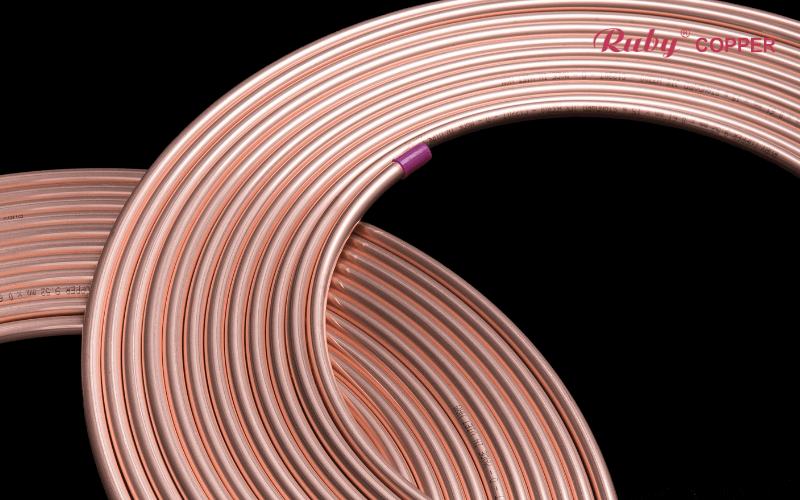
For coiled lengths with soft annealed tempers, ASTM B280-23 also specifies bright annealing after coiling. The tubes must then be dehydrated and appropriately closed at both ends. Straight lengths with hard-drawn tempers must be cleaned and closed at both ends.
These requirements demonstrate the strong HVAC and refrigeration orientation of ASTM B280.
For KS D 5301, the official Korean database confirms the product scope. Detailed technical values should be checked against the applicable full edition of the Korean standard before making a compliance claim.
This distinction matters because quoting a value from an older edition or secondary source can create a technical error.
Which Standard Should HVAC Buyers Choose?
The answer depends on the project requirement.
For a Korean project, KS D 5301 vs ASTM B280 should be evaluated according to the specification stated in the project documents or purchasing requirements.
If the Korean customer specifically requires KS D 5301, the supplier should demonstrate conformity with the applicable KS requirements.
If an international HVAC project specifies ASTM B280, the supplier should provide documentation demonstrating compliance with ASTM B280.
ASTM itself describes B280 as a specification for seamless copper tube used in field air-conditioning and refrigeration applications.
This makes ASTM B280 particularly relevant to HVAC and refrigeration contractors working with field piping.

KS D 5301, meanwhile, has a broader scope covering seamless copper and copper alloy tubes.
Therefore, the correct approach is not to ask which standard is “better.”
The correct question is whether the selected product meets the standard required by the project.
What Should International Buyers Ask a Supplier?
When evaluating KS D 5301 vs ASTM B280, procurement teams should request clear technical documentation.
First, confirm the exact standard and edition.
Second, confirm the material designation.
Third, verify the outside diameter and wall thickness.
Fourth, confirm the required temper or material condition.
Fifth, review applicable inspection and testing records.
For ASTM B280 products, buyers should pay particular attention to the requirements explicitly identified by ASTM. These include tensile properties, grain size, eddy-current testing, and cleanliness.
For KS D 5301 products, buyers should verify the applicable product designation and requirements against the current Korean standard.
This process is especially important when a supplier claims that one product complies with multiple standards.
A product may be technically suitable for both applications, but that does not mean compliance with one standard automatically proves compliance with the other.
KS D 5301 vs ASTM B280: What Does This Mean for Ruby Copper?
For international copper tube suppliers, understanding KS D 5301 vs ASTM B280 is essential when serving different markets.
Ruby Copper works with copper tube products for international HVAC and refrigeration customers. The appropriate standard should always be matched to the customer’s specification and project requirements.
For Korean customers, KS D 5301 is an important reference because it is a Korean national product standard. The official Korean database confirms its scope and current confirmation date.
For projects specifying ASTM B280, the ASTM specification provides the applicable requirements for seamless copper tube used in field air-conditioning and refrigeration applications.
The key lesson from KS D 5301 vs ASTM B280 is simple: standards should be compared by scope, material, product condition, dimensions, testing, and intended application.
A professional copper tube supplier should be able to identify the applicable standard and provide supporting technical documentation.
For contractors, OEM manufacturers, and distributors, this approach provides a stronger basis for supplier qualification and reduces the risk of selecting a product based only on a similar material designation.
Ruby Copper supports international partners with copper tube solutions and technical documentation for demanding HVAC, refrigeration, and export markets.


