

Choosing the right copper tube is critical for HVAC system reliability.
For projects in South Korea, buyers may also need products certified under Korean Industrial Standards (KS).
However, selecting KS certified copper tubes requires more than checking the KS logo.
Buyers should verify the applicable standard, certification scope, material, dimensions, temper, testing, and documentation.
This guide explains how professional contractors and HVAC buyers can evaluate KS certified copper tubes for Korean projects.
What Does KS Certification Mean for Copper Tubes?
KS is Korea’s national industrial standards system.
For copper tubes, one important standard is KS D 5301, titled Copper and Copper Alloy Seamless Pipes and Tubes.
The official Korean national standards database states that KS D 5301 covers wrought seamless copper and copper alloy tubes with round cross-sections. The current record shows a latest confirmation or revision date of April 22, 2024.
The 2024 revision also specifically lists the addition of copper tubes for air-conditioning applications. It additionally records the addition of alloy number C14435.
This is particularly relevant when evaluating KS certified copper tubes for HVAC projects.
KS Certification Is More Than a Product Claim
Korean law distinguishes between meeting a standard and receiving product certification.
Under Article 15 of Korea’s Industrial Standardization Act, designated industrial products may receive certification from an authorized certification body. Certified products may then use the prescribed product certification mark.
Article 17 further requires the certification body to assess whether the product meets the Korean Industrial Standard and the applicable certification assessment criteria. These criteria include manufacturing equipment, inspection equipment, inspection methods, and quality-control methods.
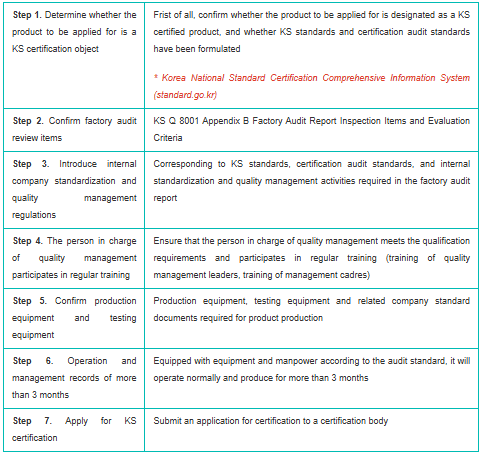
Therefore, buyers should verify the actual certificate.
A supplier’s statement that its copper tube is “manufactured according to KS” is not automatically equivalent to KS product certification.
How to Select KS Certified Copper Tubes for HVAC
The first step is to identify the exact project requirement.
A Korean HVAC project may specify KS D 5301. However, the required product designation still needs to be confirmed.
The official KS database identifies KS D 5301 as a product standard for seamless copper and copper alloy tubes.
When purchasing KS certified copper tubes, buyers should therefore check the following technical points.
1. Confirm the Applicable KS Standard
Start with the exact standard number.
For applicable seamless copper and copper alloy tubes, this may be KS D 5301.
Do not rely only on a general statement such as “KS certified.”
The certificate should identify the relevant standard and certified product.
The official Korean certification framework also uses a product certification document containing the standard name, standard number, and certified product type, grade, designation, or model.
2. Verify the Material Grade
Material designation is essential for HVAC copper tubes.
The product specification should identify the applicable copper or copper alloy grade.
KS D 5301 covers both copper and copper alloy seamless tubes.
For project procurement, the buyer should compare the material designation stated on the certificate, purchase specification, and mill documentation.
This prevents confusion between similar material designations.
3. Check Outside Diameter and Wall Thickness
Dimensional accuracy directly affects installation and system compatibility.
The buyer should define the required outside diameter and wall thickness.
The certified product must match the dimensions specified for the project.
This is particularly important when tubes are connected to fittings, valves, heat exchangers, or other HVAC components.
Do not assume that a tube is acceptable simply because it has the correct nominal diameter.
The applicable KS requirements and certified product range should be checked.
4. Confirm the Required Temper
Copper tubes can be supplied in different material conditions.
The required temper affects forming behavior and mechanical performance.
For HVAC applications, the selection may depend on whether the tube is intended for bending, installation, fabrication, or a specific equipment design.
Therefore, KS certified copper tubes should be ordered with the required temper clearly stated.
The certificate and product documentation should use consistent designations.
5. Review Inspection and Testing Requirements
Testing is another major part of supplier qualification.
Korean KS certification is not based solely on a visual inspection.
The certification assessment framework covers inspection methods and quality-control procedures.
For buyers, this means the supplier should be able to provide appropriate inspection records.
Depending on the applicable product specification, the procurement package may include dimensional inspection, chemical analysis, mechanical testing, and non-destructive testing.
The exact tests should always be checked against the current KS standard and certification assessment criteria.
What Documents Should Buyers Request?
Documentation is one of the strongest ways to verify KS certified copper tubes.
Professional buyers should request several key documents before approving a supplier.
KS Product Certificate
First, request the current KS product certificate.
Check the manufacturer name, factory location, standard number, and certified product range.
The Korean certification certificate format specifically identifies the manufacturer, factory location, standard, and certified product type or designation.
The certificate should match the supplier and manufacturing location stated in the quotation.
Mill Test and Inspection Records
Buyers should also request production and inspection documentation.
The documents should identify the material, dimensions, batch or lot, and relevant test results.
This creates traceability between the delivered tube and the certified manufacturing process.
Certificate Validity and Scope
A certificate should never be evaluated by its title alone.
Check its validity and scope.
The certification system operates through designated certification bodies and defined certification assessment procedures. KATS continues to publish official notices concerning KS certification bodies and designated certification items.
Therefore, buyers should verify that the certificate covers the actual product being purchased.
How to Evaluate a KS Certified Copper Tube Supplier
A reliable supplier should provide transparent technical information.
For international contractors, supplier evaluation should include four main areas.
First, certification: confirm the KS certificate and its scope.
Second, product specification: verify material, dimensions, temper, and applicable product type.
Third, quality control: review inspection methods and quality records.
Fourth, traceability: connect the certificate and inspection documents to the delivered production batch.
This approach is more reliable than selecting a supplier based only on price.
For projects involving KS certified copper tubes, documentation should be treated as part of the technical qualification process.
It also helps contractors reduce procurement risks during project execution.
Why KS Certified Copper Tubes Matter for Korean HVAC Projects
Korean HVAC projects can involve demanding technical and documentation requirements.
KS D 5301 is especially relevant because its 2024 revision includes provisions associated with air-conditioning copper tubes.
However, buyers should distinguish three different statements:
“Copper tube manufactured to KS requirements.”
“Copper tube tested against KS requirements.”
“Copper tube covered by a valid KS product certification.”
These statements do not necessarily have the same meaning.
For KS certified copper tubes, the strongest purchasing approach is to verify the official certificate and its certified product scope.
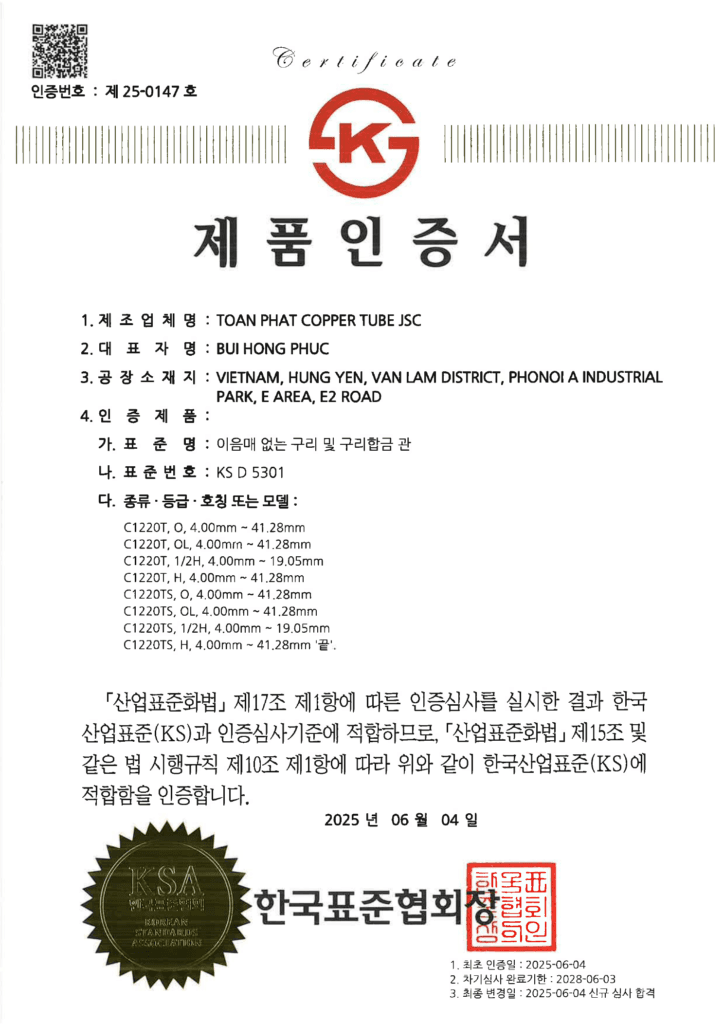
The technical specification should then be matched against the project requirements.
For Ruby Copper customers, this standards-based approach provides a clear framework for supplier qualification.
It supports professional procurement for contractors, OEMs, distributors, and HVAC system integrators.
Ultimately, the right copper tube is not simply the product with the lowest price.
It is the product with verified conformity, suitable technical specifications, reliable quality control, and complete documentation.
For Korean HVAC projects, these factors are essential when selecting KS certified copper tubes.


