
When sourcing copper tubes for HVAC, refrigeration, or industrial applications, buyers may encounter both C1220 and C12200. At first glance, these designations look almost identical. This often leads to an important question: C1220 vs C12200 – are they the same copper grade?
The short answer is: they refer to closely related phosphorus-deoxidized copper designations, but they should not be treated as automatically identical specifications.
The difference comes mainly from the standard system used to identify the material. C1220 is commonly used in Japanese and Korean standards, while C12200 is a UNS designation used internationally in North American material systems.
Understanding this distinction is important when purchasing copper tubes for demanding projects. Material designation alone does not confirm that two products meet the same dimensional, mechanical, or certification requirements.
What Does C1220 Mean?
C1220 is a copper material designation used in standards such as JIS and KS. It refers to phosphorus-deoxidized copper used for wrought copper products, including seamless tubes.
The current KS D 5301 covers seamless copper and copper alloy pipes and tubes with round cross-sections produced through wrought processing. The standard was revised in April 2024.
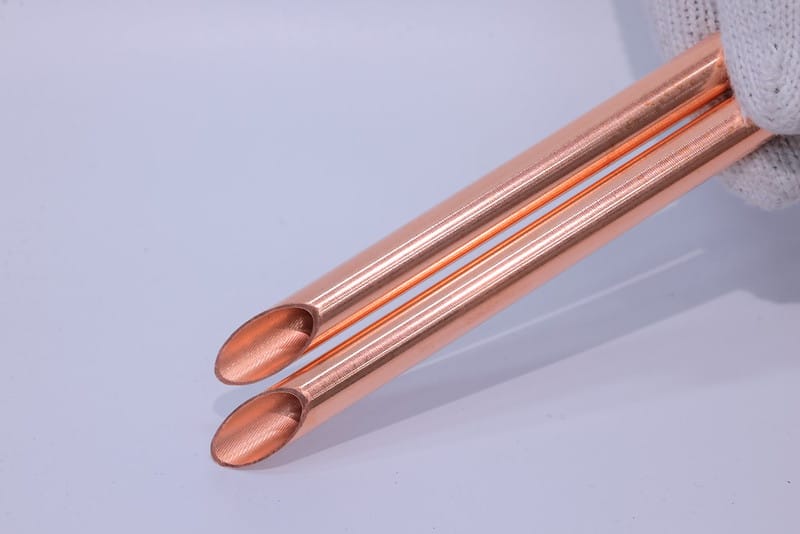
C1220 is also included in the JIS system. JIS H 3300:2018 specifies seamless copper and copper alloy tubes with round cross-sections made through wrought processing. The standard remains valid following its 2023 confirmation.
For Korean HVAC projects, the designation can appear in a more complete form. For example, KS D 5301 certification may identify products as C1220T or C1220TS, together with a temper such as O, OL, 1/2H, or H.
Therefore, C1220 vs C12200 should first be understood as a comparison between designation systems rather than simply two different copper alloys.
What Does C12200 Mean?
C12200 is the corresponding UNS designation for phosphorus-deoxidized, high-residual-phosphorus copper, commonly known as DHP copper.
According to the Copper Development Association’s alloy database, C12200 contains at least 99.9% copper. Its phosphorus content is specified from 0.015% to 0.040%.
C12200 is an active UNS wrought copper designation. The UNS database identifies it as Phosphorus-Deoxidized, High Residual P (DHP).
This material is widely used for applications requiring good fabrication characteristics. Depending on the product form and temper, C12200 can be suitable for processes such as drawing, forming, bending, brazing, and soldering.
However, buyers should not assume that every product marked C12200 has identical properties. Mechanical performance depends on the product form, dimensions, manufacturing condition, and temper.
C1220 vs C12200: Why Are the Numbers Different?
The key point in C1220 vs C12200 is the numbering system.
C1220 is a designation used by standards such as JIS and KS.
C12200 is a UNS designation.
UNS uses a five-digit numerical system for wrought copper and copper alloys. The Copper Development Association lists C12200 as DHP wrought copper.
Because different standards use different designation systems, the absence or presence of an additional zero does not by itself indicate a different copper chemistry.
For procurement purposes, however, it is better to avoid simply replacing one designation with the other. The applicable standard should always be identified.
C1220 vs C12200: Are They Chemically the Same?
In practical copper tube sourcing, C1220 vs C12200 is often discussed because both designations describe phosphorus-deoxidized copper with closely related chemical characteristics.
For C12200, the Copper Development Association specifies:
- Copper: minimum 99.9%
- Phosphorus: 0.015–0.040%
- Alloy type: Phosphorus-Deoxidized, High Residual P
- UNS status: Active
C1220 is likewise associated with phosphorus-deoxidized copper in JIS and KS applications.
However, a professional specification should not state that C1220 and C12200 are universally interchangeable. Chemical composition is only one part of a tube specification.
The applicable standard may also define requirements for dimensions, tolerances, mechanical properties, testing, surface quality, temper, and other product characteristics.
This distinction matters when a project specification calls for a specific standard.
Why the Standard Matters More Than the Material Number
For international contractors, the question C1220 vs C12200 should not stop at chemical composition.
A copper tube specification normally contains several layers of information.
First, the buyer needs to identify the material designation.
Second, the buyer should identify the product standard. Examples include KS D 5301, JIS H 3300, or an applicable ASTM specification.
Third, the buyer needs to specify the temper. For example, copper tube products may be supplied in annealed or harder conditions depending on the applicable standard.
Fourth, dimensional requirements must be defined. These include outside diameter, wall thickness, length, and applicable tolerances.
Finally, testing and certification requirements should be confirmed.
This is especially important for Korean projects. The current KS certification registry lists TOAN PHAT COPPER TUBE JSC under KS D 5301. Its certified scope includes C1220T and C1220TS in O, OL, 1/2H, and H tempers, with specific dimensional ranges.
Therefore, a buyer should verify the complete certified designation rather than relying only on the basic C1220 material number.
C1220 vs C12200 for HVAC Copper Tube Applications
Both designation systems are relevant when specifying copper tubes for HVAC and refrigeration applications.
Copper tubes based on phosphorus-deoxidized copper are commonly selected where reliable forming and joining performance are required. Their suitability for a specific application still depends on the applicable product standard and engineering requirements.
For international HVAC projects, procurement teams may encounter different terminology depending on the destination market.
A Korean project may specify KS D 5301 and C1220.
A Japanese project may reference JIS H 3300 and C1220.
A North American specification may use UNS C12200 together with an applicable ASTM product standard.
This is why C1220 vs C12200 should be treated as a standards-identification issue as much as a material-identification issue.
For a global copper tube supplier, the ability to map material designations correctly is essential. It helps prevent purchasing errors and avoids assuming that two products are equivalent without checking the complete specification.
How Should Buyers Specify C1220 or C12200?
When requesting a quotation, contractors and distributors should provide more information than the copper grade alone.
A strong technical inquiry should include:
- Applicable product standard.
- Copper material designation.
- Temper or delivery condition.
- Outside diameter.
- Wall thickness.
- Length or coil configuration.
- Dimensional tolerances.
- Mechanical requirements where applicable.
- Required inspection and testing.
- Certification or conformity requirements.
For example, asking for “C1220 copper tube” may not provide enough information for a supplier to quote the correct product.
A better specification identifies the applicable standard and complete product requirements.
This approach is particularly important for projects involving KS certification. KS D 5301 is the relevant Korean standard for seamless copper and copper alloy tubes, and its current version was published on April 22, 2024.
Conclusion: Is C1220 the Same as C12200?
So, C1220 vs C12200 – are they the same copper grade?
The most accurate answer is that they are closely corresponding designations for phosphorus-deoxidized copper used under different standards and designation systems. C1220 is used in JIS and KS contexts, while C12200 is the UNS designation for DHP wrought copper.
However, buyers should not treat the two numbers as automatically interchangeable in every specification.
The correct approach is to compare the complete requirements. These include the applicable standard, chemical composition, temper, dimensions, tolerances, mechanical properties, testing, and certification scope.
For global HVAC contractors and distributors, this distinction provides a more reliable basis for supplier evaluation.
Ruby Copper can support international customers by aligning copper tube specifications with the required market standards and project requirements. For Korean-market projects, the company’s current KS D 5301 certification specifically covers certified C1220T and C1220TS products across defined tempers and size ranges.


