
When specifying copper tubes for HVAC and refrigeration systems, material grade is only one part of the specification. Dimensional accuracy can also affect installation and system performance.
This is why buyers often compare C1220T vs C1220TS when reviewing copper tube specifications under Japanese or Korean standards.
Both designations refer to C1220 phosphorus-deoxidized copper. The main distinction is the grade of dimensional tolerance.
For international contractors, OEMs, and distributors, understanding this difference helps prevent incorrect product selection. It also makes technical discussions with suppliers more precise.
What Do C1220T and C1220TS Mean?
Under the KS D 5301 designation system, C1220 identifies the copper material. The letters T and TS identify different grades.
A Korean government KS designation guide defines T as the ordinary grade and TS as the special grade. The designation also separates the grade from the temper, such as O, OL, 1/2H, and H.
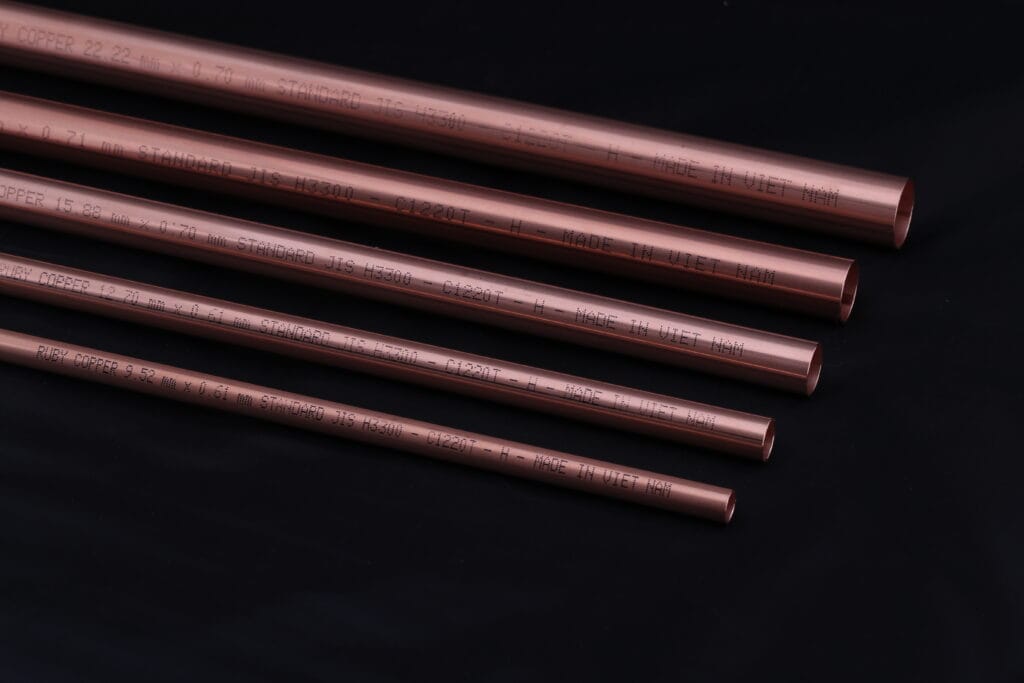
Therefore, C1220T vs C1220TS is not primarily a comparison between two different copper alloys.
Both use the C1220 material designation. The difference relates mainly to the specified product grade and dimensional requirements.
This distinction is important because a buyer should not interpret TS as a different copper chemistry.
C1220T vs C1220TS in the Product Designation
A KS D 5301 product designation can combine several elements.
For example:
KS D 5301 – C1220 – T – O
Here, C1220 identifies the material. T identifies the grade. O identifies the temper.
A corresponding special-grade product can be designated:
KS D 5301 – C1220 – TS – O
The material and temper remain identifiable separately.
This structure allows buyers to specify both the copper grade and the required mechanical condition.
C1220T vs C1220TS: What Is the Main Difference?
The most important difference in C1220T vs C1220TS is dimensional tolerance.
T represents the ordinary grade. TS represents the special grade with tighter dimensional requirements.
A technical reference based on JIS H 3300 illustrates this distinction. For example, the listed average-diameter tolerance for TS is tighter than T across the referenced diameter ranges.
This means TS is intended where greater dimensional control is required.

The distinction can apply to parameters such as outside diameter or other specified dimensional characteristics.
The exact tolerance must always be checked against the applicable edition of the product standard.
Does TS Mean Higher Copper Purity?
No.
The T and TS designations do not represent two different copper alloy compositions.
For C1220, the chemical composition is defined by the applicable standard. A JIS H 3300 reference identifies C1220 with copper at 99.90% minimum and phosphorus at 0.015–0.040%.
Therefore, C1220T vs C1220TS should not be described simply as “standard copper” versus “higher-purity copper.”
The difference is related to the product grade and its dimensional requirements.
This distinction matters when preparing technical specifications for international projects.
How Does Temper Affect C1220T and C1220TS?
Another important point in C1220T vs C1220TS is the role of temper.
The grade and temper are separate elements of the designation.
KS documentation identifies O, OL, 1/2H, and H as different tempers. The Korean government designation guide lists these tempers separately from T and TS.
In practical terms, this means both T and TS can be associated with different tempers where permitted by the standard.
For example, KS certification records can list:
- C1220T-O
- C1220T-OL
- C1220T-1/2H
- C1220T-H
- C1220TS-O
- C1220TS-OL
- C1220TS-1/2H
- C1220TS-H
The current KS certification registry for Toan Phat Copper Tube JSC lists both C1220T and C1220TS across these temper categories.
Therefore, buyers should not select T or TS based only on the required hardness or flexibility.
The temper must also be specified.
Which One Should HVAC Buyers Choose?
For C1220T vs C1220TS, the right choice depends on the project’s dimensional requirements.
When C1220T May Be Suitable
C1220T can be appropriate when standard dimensional tolerances meet the project specification.
This can simplify procurement when the application does not require tighter dimensional control.
However, the supplier must still meet the applicable KS or JIS requirements.
When C1220TS May Be Preferred
C1220TS is relevant when tighter dimensional control is required.
This can be important for applications involving precise tube dimensions, controlled assembly, or demanding manufacturing processes.
For HVAC and refrigeration projects, dimensional consistency can support reliable tube forming, joining, and component assembly.
However, TS should not automatically be described as “better” than T.
It is more accurate to describe TS as a special grade with stricter dimensional requirements.
The correct choice depends on the project’s engineering specification.
Why the Difference Matters for International Procurement
Understanding C1220T vs C1220TS is particularly important when purchasing copper tubes across different markets.
A specification may reference KS D 5301, JIS H 3300, or another national standard.
These standards can use similar material designations while applying their own product requirements.
Therefore, a buyer should verify more than the C1220 designation.
The purchase specification should clearly identify:
- Applicable product standard
- C1220 material designation
- T or TS grade
- Required temper
- Outside diameter
- Wall thickness
- Dimensional tolerances
- Mechanical requirements
- Inspection and testing
- Certification and quality documentation
This approach reduces the risk of receiving a product that matches the material grade but does not match the required dimensional specification.
For Korean projects, certification scope is also critical.
The KS certification registry shows that certified products can have specific combinations of material, grade, temper, and size range.
Therefore, buyers should verify that the supplier’s certificate covers the exact product being purchased.
C1220T vs C1220TS: Key Takeaway
The simplest way to understand C1220T vs C1220TS is to separate material, grade, and temper.
C1220 identifies the copper material.
T identifies the ordinary product grade.
TS identifies the special product grade with tighter dimensional requirements.
O, OL, 1/2H, and H identify the applicable temper.
This structure is important when specifying copper tubes for professional HVAC, refrigeration, and industrial applications.
For global contractors and OEMs, the best practice is to specify the complete designation rather than using “C1220” alone.
The supplier should also provide documentation confirming the applicable standard, product grade, dimensions, testing, and certification scope.
For projects targeting Korea, this is especially important when KS D 5301 compliance is required.
Ruby Copper’s KS certification record demonstrates that its certified product scope includes both C1220T and C1220TS, subject to the specific temper and dimensional range listed in the certification record.
This gives international buyers a clear basis for evaluating the appropriate C1220 tube specification for their application.


