

Choosing the right material for HVAC and refrigeration systems directly affects cooling performance, durability, installation quality, and long-term operating costs. Among the most commonly used materials, copper tubes and aluminum tubes are the two main options in the HVAC industry.
In this article, Ruby Copper compares copper tubes vs aluminum tubes for HVAC systems to help contractors, distributors, and manufacturers choose the right solution for their applications.
Superior Thermal Conductivity
Copper offers significantly better thermal conductivity than aluminum, allowing HVAC systems to transfer heat faster and more efficiently.
This helps improve:
- Cooling performance
- Energy efficiency
- System stability
- Heat exchanger effectiveness
Because of its high thermal performance, copper tubing remains the preferred choice for air conditioning systems, VRF systems, and industrial refrigeration applications.
Better Durability and Corrosion Resistance
HVAC systems often operate in humid, outdoor, or high-pressure environments. Copper tubes provide stronger corrosion resistance and longer operating lifespan compared to aluminum tubes.
Copper tubing helps reduce risks such as:
- Refrigerant leakage
- Pipe cracking
- Corrosion damage
- Long-term maintenance issues
This durability makes copper tubes ideal for commercial HVAC projects and high-demand cooling systems.
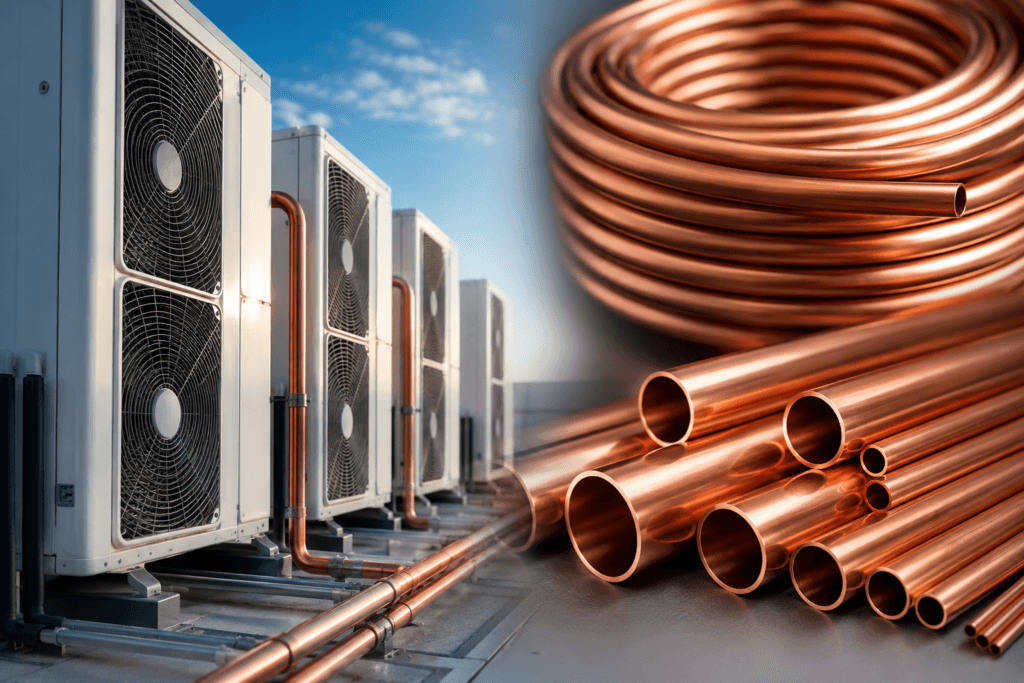
Higher Pressure Resistance
Modern refrigerants such as R410A and R32 require tubing materials that can withstand high operating pressure. Copper tubes manufactured under ASTM B280 standards provide reliable pressure resistance for modern HVAC systems.
Compared to aluminum, copper tubing offers:
- Better structural strength
- Higher pressure tolerance
- Improved long-term reliability
- Safer operation
Easier Installation and Maintenance
Copper tubes are flexible, easy to bend, and compatible with brazing and welding processes commonly used in HVAC installation.
Advantages of copper tubing installation include:
- Easy fabrication
- Faster installation
- Reliable pipe connections
- Reduced leakage risks
- Easy repair and maintenance
Aluminum tubes may require specialized joining methods and are generally more difficult to repair after damage.

Long-Term Cost Efficiency
Although aluminum may have a lower initial material cost, copper tubes often provide better long-term value due to:
- Longer service life
- Lower maintenance costs
- Higher energy efficiency
- Reduced replacement frequency
For many HVAC manufacturers and contractors, copper tubing offers lower total lifecycle costs despite higher initial investment.
Copper vs Aluminum Tubes Comparison
| Feature | Copper Tube | Aluminum Tube |
|---|---|---|
| Thermal Conductivity | Excellent | Moderate |
| Corrosion Resistance | High | Lower |
| Pressure Resistance | Excellent | Lower |
| Durability | Long lifespan | Shorter lifespan |
| Maintenance | Easy repair | More difficult |
| Lifecycle Cost | Lower long-term cost | Higher replacement risk |
Ruby Copper – Reliable HVAC Copper Tube Manufacturer
Ruby Copper manufactures high-quality copper tubes and coils for global HVAC and refrigeration industries. Our products are made from 99.95% pure copper and comply with international standards including ASTM, JIS, EN, and ISO certifications.
With advanced manufacturing technology and strict quality control systems, Ruby Copper supplies reliable copper tube solutions to customers in more than 40 countries worldwide.
Contact Ruby Copper
Looking for a reliable copper tube manufacturer for HVAC systems?
Contact Ruby Copper today for product catalogs, technical support, and OEM cooperation opportunities.


